Off-Grid Electricity Explained in Plain English

Off-Grid Electricity Explained in Plain English
Living off-grid means your system makes, stores, and delivers electricity for your tiny house. That can sound complicated at first. It gets easier when you learn a few simple ideas.
The big idea is this: your house needs enough power right now and enough energy over time. Solar panels help make electricity. Batteries save energy for later. An inverter helps many home appliances use that energy.
What path does electricity take in an off-grid tiny house?
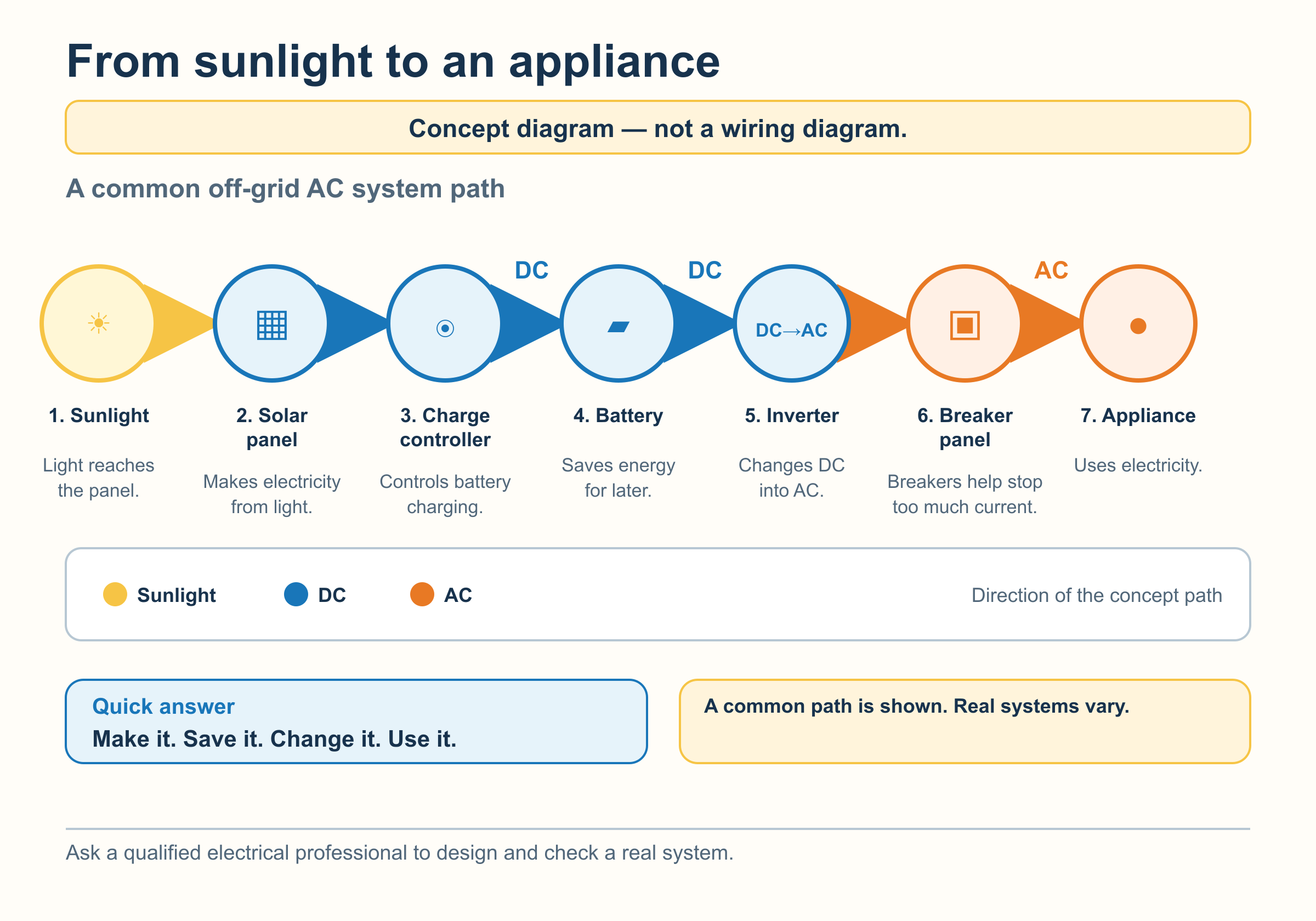
Here is a simple way to remember the job of the system:
- Make it: Solar panels make DC electricity from sunlight.
- Save it: A battery stores energy for later.
- Change it: An inverter changes DC power into AC power for many household appliances.
- Use it: A light, fan, refrigerator, or other appliance uses the power.
A charge controller helps the solar panels charge the battery in a controlled way. Breakers and fuses are safety devices that can stop too much current from flowing.
This is a concept picture, not a wiring diagram. Real systems can be arranged differently.
What do volts, amps, and watts mean?

These words help describe electricity.
- Volts describe electrical push.
- Amps describe electrical flow.
- Watts describe how much power is being made or used right now.
For a simple DC example, volts × amps = watts.
The water picture is a memory helper, not a perfect match. No tiny water pipes are hiding in your wires.
You do not need to do electrical math every time you use an appliance. But the words help you read labels and understand why some things need more power than others.
What is the difference between watts and watt-hours?

Watts tell you about power at one moment. Watt-hours tell you how much energy was used over time.
A 100-watt lamp uses 100 watts while it is on. If it stays on for 3 hours, it uses 300 watt-hours of energy.
100 watts × 3 hours = 300 watt-hours
This is why a small appliance can still matter if it runs for many hours. It is also why a high-power appliance can use less daily energy if it runs for only a few minutes.
What do the main parts of the system do?
| Part | Plain-English job |
|---|---|
| Solar panel | Makes DC electricity from sunlight. |
| Charge controller | Helps the panels charge the battery in a controlled way. |
| Battery | Stores energy for later. |
| Inverter | Changes DC power into AC power for many household appliances. |
| Breaker or fuse | A safety stop that can interrupt too much current. |
These parts work together. One part cannot do every job. For example, a solar panel makes electricity in sunlight, but a battery helps make energy available after the sun goes down.
How does appliance use add up over a day?

The easiest place to start is a simple list. Write down each appliance, its watts, how long it runs, and the watt-hours it uses.
Here is a classroom-style example for a hypothetical tiny house. These numbers are not a system recommendation. Real appliance use varies.
| Hypothetical use | Power | Time | Energy |
|---|---|---|---|
| Five LED lights | 40 W total | 5 hours | 200 Wh |
| Compact refrigerator | 45 W | 8 estimated running hours | 360 Wh |
| Fan | 60 W | 8 hours | 480 Wh |
| Microwave | 800 W | 15 minutes | 200 Wh |
| Laptop | 70 W | 3 hours | 210 Wh |
| Small water pump | 100 W | 12 minutes | 20 Wh |
| Example daily total | 1,470 Wh, or 1.47 kWh |
The refrigerator is plugged in all day, but its motor only runs part of the time. That is why this example uses 8 running hours.
The microwave needs a lot of power while it runs. But it runs for only 15 minutes in this example. The fan needs less power, but it runs much longer. Both add to the day’s energy total.
When you are ready to use your own appliance list for a planning estimate, try the Tiny House Solar Calculator.
Why does battery charge go up and down?

Battery state of charge means how full the battery is. During sunny hours, solar can add energy to the battery. At night, appliances use energy from it.
The graph is only an example. Weather, shade, solar output, appliance use, battery type, and system settings all change what happens in a real tiny house.
Do not use a picture like this to choose battery settings. Follow the battery and system documentation, and get qualified help for the actual system design.
For a more detailed stored-energy planning estimate, use the Tiny House Battery Bank Calculator.
What are continuous watts and surge watts?
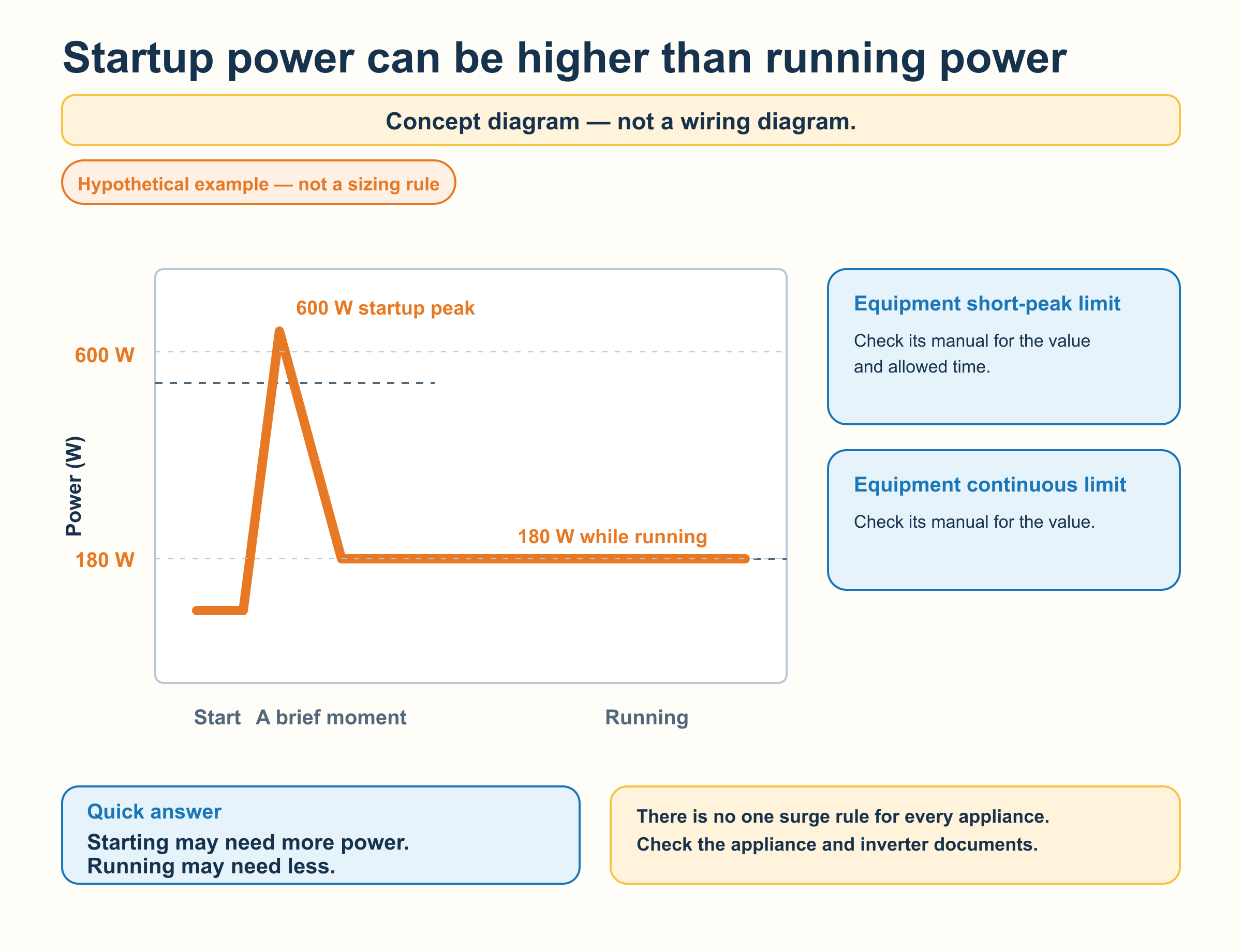
Some appliances need a short extra burst of power when they start. Some appliances, including some equipment with motors, may do this. After they start, they may use less power while they keep running.
- Continuous watts are the power needed while something keeps running.
- Startup or surge watts are the brief extra power some equipment may need to start.
In the visual example, a device briefly reaches 600 watts when starting and then runs at 180 watts. Those are made-up teaching numbers, not a sizing rule. Check the appliance and inverter documentation for real equipment.
Why do wires, grounding, breakers, and fuses matter?
They are part of the safety system.
Wires need to be suitable for the electricity they carry. Grounding and bonding help provide a safe path when something goes wrong. Breakers and fuses help protect circuits from too much current.
Do not guess at wire size, breaker or fuse size, grounding details, or battery settings. Those choices depend on the full system, equipment instructions, and local requirements. Ask qualified electrical help to design and check the real system.
Words you may see
AC (alternating current): A type of electricity used by many household appliances.
Amp: A measure of electrical flow.
Amp-hour (Ah): A battery label unit that helps describe capacity. It needs the battery voltage and other details to tell the whole energy story.
Appliance: A thing that uses electricity, such as a light, fan, refrigerator, or microwave.
Battery: Stores energy for later.
Breaker or fuse: A safety device that can interrupt too much current.
Charge controller: Helps solar panels charge a battery in a controlled way.
Continuous power: Power something needs while it keeps running.
DC (direct current): A type of electricity used by solar panels and batteries.
Inverter: Changes DC power into AC power for many household appliances.
Grounding and bonding: Parts of the safety system that help carry fault current safely when something goes wrong.
Kilowatt-hour (kWh): 1,000 watt-hours. Utility bills and battery labels often use this unit.
Off-grid: Not depending on the usual utility grid for electricity. An off-grid system makes and stores energy for the tiny house.
State of charge: How full a battery is.
Surge power: A short extra burst of power that some equipment needs when it starts.
Volt: A measure of electrical push.
Watt: A measure of how much power is being made or used right now.
Watt-hour (Wh): A measure of energy used over time.
A simple next step
First, make a list of what you want to run and how long you use it each day. Then use that list to have a clear conversation with a qualified person about a safe off-grid electrical system.
Some links on this page are affiliate links. See our affiliate disclosure.